



目次 | Contents
1. はじめに:なぜ「4月」からの内服ケアが論理的なのか
春の訪れとともに心地よい日差しが増える4月ですが、皮膚科学的な視点に立つと、この時期は一年の中で最も「防御の隙」が生まれやすい危険なフェーズです。日本国内の気象学的解析によれば、3月の紫外線量は真夏の約60%ですが、4月には約80%にまで急増します 。この絶対量は、残暑が厳しい9月と同等、あるいはそれ以上です 。
しかし、気温が過ごしやすいために主観的な熱感や痛みが少なく、多くの方が本格的な紫外線対策を5月以降に先送りしてしまう傾向にあります 。さらに、冬季の低紫外線環境下でメラニンが減少し、バリア機能が低下した「無防備状態」の皮膚にとって、急増するUV-A(320-400nm)は真皮深層にまで到達し、蓄積的な光老化の決定的な要因となります 。
本記事では、当院院長の監修のもと、最新の医学的エビデンスに基づいた「内服的光防御(飲む日焼け止め)」の有効性と、その具体的な活用プロトコルについて論理的に解説します。単なる美容習慣ではなく、分子レベルでの「細胞保護」という視点から、春季の皮膚戦略を再構築していきましょう。
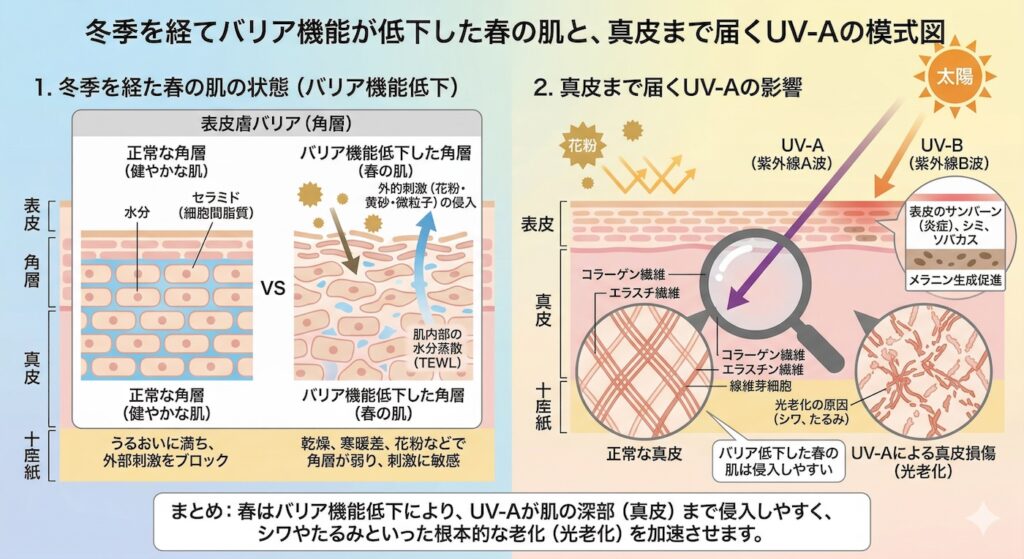
2. エビデンスに基づく主要成分の機序:PLEとニコチンアミド
現在、内服的光防御成分の中で最も強固なエビデンスを有するのは、ポリポディウム・レウコトモス(PLE)とニコチンアミド(ビタミンB3)です。これらの成分は、外用剤では到達できない「細胞内部の修復プロセス」を支援します。
2.1 ニコチンアミド(NAM):エネルギー危機からの脱却
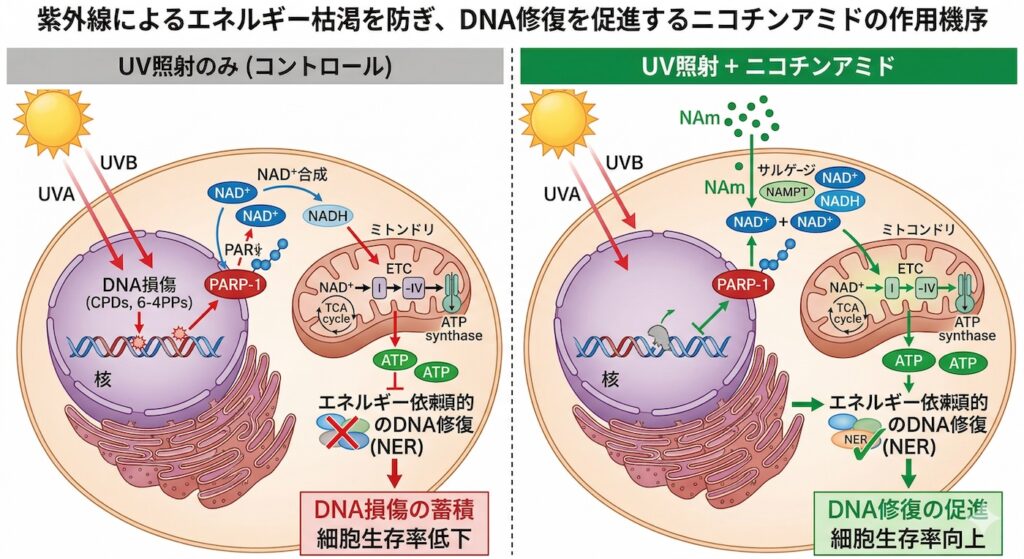
ニコチンアミドは、細胞内のエネルギー代謝に不可欠なNAD+の前駆体です。紫外線によるDNA損傷の修復には膨大なATP(細胞内エネルギー)が必要ですが、UV曝露はPARP(ポリADPリボースポリメラーゼ)を過剰活性化させ、NAD+を枯渇させて細胞を「エネルギー危機」に陥らせます 。
- 臨床的エビデンス:2015年の第3相試験(ONTRAC試験)および2025年の大規模コホート研究(n=33,833)において、ニコチンアミド500mgを1日2回服用することで、非メラノーマ皮膚癌(NMSC)の新規発生率が23%〜54%減少することが統計学的に証明されています 。
- 主な役割:DNA修復効率の劇的な向上と、UV誘発性の免疫抑制の回避です 。
2.2 ポリポディウム・レウコトモス(PLE):マルチターゲットな防御
中米原産のシダ植物から抽出されるPLE(フェーンブロック)は、単一の抗酸化剤ではなく、フェルラ酸やカフェイン酸などの相乗作用により多角的に作用します。
- 最小紅斑量(MED)の上昇:複数のRCT(ランダム化比較試験)において、PLEの内服がMED(日焼けを起こす最小の紫外線量)を有意に上昇させることが証明されています 。
- 光老化の抑制:コラーゲンを分解する酵素であるMMP-1の発現を抑制し、光老化の土台形成を防ぎます 。
- 免疫保護:表皮のランゲルハンス細胞の形態と密度を維持し、皮膚の免疫監視機能を保護します。これは外用剤では代替不可能な内服特有のメリットです 。
3. 「飲む日焼け止め」の限界と2026年の最新トピック
3.1 「単独での完全防御」の否定
誤解してはならないのは、内服剤のみで十分なSPF値を確保することは不可能であるという事実です。内服によって得られる全身的なSPF値は、3ヶ月間の継続服用後であっても1.56未満に留まります 。したがって、内服ケアはあくまで「外用サンスクリーン剤および物理的遮蔽の補助的手段」として位置づけられるべきです 。
3.2 UVA1、ブルーライト、そして「ダークCPD」
2025年以降の最新研究では、従来のUVB対策だけでは不十分であることが明確になっています。
- UVA1(340-400nm)と可視光線:これらは難治性の肝斑や色素沈着を悪化させます。最新の成分「2-MNG(Melasyl)」は、メラニン合成経路のドパキノンに直接結合し、ブルーライト誘発性の黒ずみを物理的に遮断する画期的な機序を持ちます 。
- ダークCPD(Dark CPD)現象:紫外線曝露後、暗所に移動した後も数時間にわたってDNA損傷が進行し続ける現象が解明されました 。この遅延型の損傷を食い止めるには、内服による持続的な抗酸化ネットワークの維持が不可欠です 。
4. 実務的な「内側からのケア」推奨ルーチン
本記事は医師の医学的知見をもとに作成しており、当院では以下のプロトコルを推奨しています。
- 準備期(3月中旬〜末):
- 皮膚バリア機能を高める保湿(セラミド等)の徹底 。
- 抗酸化活性を高めるため、アスタキサンチン等の内服を開始 。
- 集中防御期(4月初旬〜):
- PLE(240-480mg/日):毎朝服用。長時間屋外にいる場合は4時間後に追加服用 。
- ニコチンアミド(500mg×2回/日):特に皮膚癌リスクの低減を目的とする場合に推奨 。
- レスキュー期(曝露後):
- 日焼け当日はニコチンアミドを摂取し、DNA修復のためのエネルギーを補給 。
- 徹底した冷却と保湿を行う 。
よくある質問(FAQ)
いいえ、必須です。内服剤のSPF値は1.56未満と極めて低く、外用剤の代用にはなりません 。外用剤が「盾」なら、内服剤は「防弾チョッキ」や「損傷の修理部隊」と考えるのが適切です。
一般的な用量では安全性が高いですが、高用量(1,000mg/日以上)では血糖値の上昇や肝機能指標の変動を招く可能性が指摘されています 。糖尿病をお持ちの方は主治医にご相談ください。
既存の臨床試験の多くは成人を対象としており、18歳未満に対する長期的な有効性と安全性については十分なデータが確認されていません 。まずは外用剤と帽子等による物理的遮蔽を優先してください。
PLEは曝露の少なくとも15日前から、アスタキサンチンは3〜4週間前から内服を開始することが実務上推奨されています 。
まとめ 兼 当院の取り組み
紫外線が「4月から強い」という事実は、皮膚の健康維持におけるクリティカルな転換点です 。PLEやニコチンアミドを軸とした内服的光防御は、外用剤だけでは防ぎきれない真皮レベルの光老化やDNA変異を抑制するための、極めて論理的な手段です 。
当院では、最新の2025-2026年エビデンスに基づき、患者様一人ひとりのライフスタイルや肌質に合わせた「精密な光防御計画(Precision Photoprotection)」を提案しています。単なるサプリメントの処方に留まらず、治療後の炎症後色素沈着(PIH)リスク管理など、QOL(生活の質)を重視した治療を行っております。
春の数週間の油断が、数年後のシワやシミの「土台」を作ります 。手遅れになる前に、科学的根拠に基づいた内側からのケアを取り入れましょう。
監修:あおぞらクリニック 院長 医師
【医学的エビデンスの位置づけ】
- ニコチンアミドによるNMSC予防:★★★★★(大規模コホート・第3相RCTあり)
- PLEによるMED上昇・日焼け抑制:★★★★☆(複数のRCTあり)
- アスタキサンチンによる肌弾力改善:★★★☆☆(メタ解析はあるが不均一性あり)
- 内服剤単独での完全防御:★☆☆☆☆(科学的に否定済み)
Dermatologic Applications of Polypodium leucotomos: A Literature Review – PMC, https://pmc.ncbi.nlm.nih.gov/articles/PMC8211346/
Study reveals efficacy of nicotinamide for skin cancer prevention – Vanderbilt Health News, https://news.vumc.org/2025/09/17/study-reveals-efficacy-of-nicotinamide-for-skin-cancer-prevention/
Nicotinamide for Skin Cancer Chemoprevention – https://pubmed.ncbi.nlm.nih.gov/40960808/
Nicotinamide: An Update and Review of Safety & Differences from Niacin,https://www.skintherapyletter.com/basal-cell-carcinoma/nicotinamide-update-niacin/
Safety and Efficacy of Oral Polypodium leucotomos Extract in Healthy Adult Subjects – PMC, https://pmc.ncbi.nlm.nih.gov/articles/PMC4345929/
Effectiveness of dietary supplements for skin photoaging … – Frontiers, https://www.frontiersin.org/journals/medicine/articles/10.3389/fmed.2025.1582946/ full
Effects of Astaxanthin Supplementation on Skin Health: A Systematic Review of Clinical Studies – PubMed, https://pubmed.ncbi.nlm.nih.gov/32202443/
Exposure to Non-Extreme Solar UV Daylight: Spectral Characterization, Effects on Skin and Photoprotection – PMC, https://pmc.ncbi.nlm.nih.gov/articles/PMC4307236/
The impact of methoxypropylamino cyclohexenylidene ethoxyethylcyanoacetate (MCE) UVA1 filter on pigmentary and ageing signs: An outdoor prospective 8-week randomized, intra-individual comparative study in two populations of different genetic background – ResearchGate, https://www.researchgate.net/publication/373584451
Photoprotection for Skin Cancer: What’s New – PMC, https://pmc.ncbi.nlm.nih.gov/articles/PMC12939393/
Systemic Photoprotection in Skin Cancer Prevention: Knowledge among Dermatologists, 4月 2, 2026にアクセス、https://www.mdpi.com/2218-273X/11/2/332
Prospective Evaluation of the Efficacy of a Food Supplement in Increasing Photoprotection and Improving Selective Markers Related to Skin Photo-Ageing – PMC, https://pmc.ncbi.nlm.nih.gov/articles/PMC6994571/
Changes in ultraviolet B radiation-induced DNA damage and erythema after oral nicotinamide and polypodium leucotomos in, https://d-nb.info/1387031287/34
Systematic Review and Meta-Analysis on the Effects of Astaxanthin on Human Skin Ageing, https://pmc.ncbi.nlm.nih.gov/articles/PMC8472736/
Astaxanthin and Human Health: Evidence on Skin, Vision, Brain, and Aging, https://www.news-medical.net/health/Astaxanthin-and-Human-Health-Evidence-on-Skin-Vision-Brain-and-Aging.aspx
Oral Supplements and Photoprotection: A Systematic Review, https://pubmed.ncbi.nlm.nih.gov/39804624/
Oral Photoprotection: Effective Agents and Potential Candidates – PMC, 4月2, 2026にアクセス、https://pmc.ncbi.nlm.nih.gov/articles/PMC6028556/
Photoprotection for Skin Cancer: What’s New – MDPI, https://www.mdpi.com/2072-6694/18/4/634
Drug interactions of natural supplements in…: International Journal of Dermatology – Ovid, https://www.ovid.com/journals/ijderm/fulltext/10.1111/ijd. 15389
皮膚悪性腫瘍診療ガイドライン第2版, https://www.dermatol.or.jp/dermatol/wp-content/uploads/xoops/files/guideline/guideline SknCncr.pdf
UV Protection Habits and Preferences in Patients With Distinct Cutaneous Immune-Mediated Inflammatory Diseases – PMC, 4月2,2026にアクセス、https://pmc.ncbi.nlm.nih.gov/articles/PMC12989706/
Efficacy of a 2-MNG-Containing Serum and Sunscreen Regimen on Improving Facial Dyschromia in Women with Skin of Color – The Journal of Clinical and Aesthetic Dermatology, 4月2,2026にアクセス、https://jcadonline.com/efficacy-serum-sunscreen-regimen-facial-dyschromia/
Visible Light Protection Strategies for Diverse Populations – PMC – NIH, 4月2, 2026にアクセス、https://pmc.ncbi.nlm.nih.gov/articles/PMC12936234/
Sunscreens with the New MCE Filter Cover the Whole UV Spectrum: Improved UVA1 Photoprotection In Vitro and in a Randomized Controlled Trial – ResearchGate, https://www.researchgate.net/publication/356252771
Topical prevention from high energy visible light-induced pigmentation by 2-mercaptonicotinoyl glycine, but not by ascorbic acid antioxidant – PMC,https://pmc.ncbi.nlm.nih.gov/articles/PMC12546040/
(PDF) Gain of photoprotection afforded by the cyclic merocyanine UVA1 absorber MCE® in sunscreen formulae: A dose effect in vivo clinical trial – ResearchGate, https://www.researchgate.net/publication/367454109
(PDF) Evaluation of the Efficacy of a 2-MNG-Containing Serum on Improving Skin Tone and Hyperpigmentation – ResearchGate, https://www.researchgate.net/publication/399010136
Enzymes DNA Repair in Skin Photoprotection: Strategies Counteracting Skin Cancer Development and Photoaging Strategies – MDPI, https://www.mdpi.com/2079-9284/12/4/172
Uses of Polypodium leucotomos Extract in Oncodermatology – https://pmc.ncbi.nlm.nih.gov/articles/PMC9861608/
Nicotinamide Supplement Reduces Risk of skin Cancer,https://www.cornerstonedermatology.com/blog/2021/nicotinamide
Beyond Sunscreen: The use of complementary and alternative sun protection methods has become increasingly popular. | Journal of Integrative Dermatology, https://jintegrativederm.org/doi/10.64550/joid.rt12fj47
コメント